
Chess and Jiu-Jitsu: Strategic Parallels Between the Royal Game and the Gentle Art
Explore the fascinating connections between chess and BJJ - from opening theory and positional advantage to pattern recognition and the mental game.
Share this page
Ready to Track Your Progress?
Join practitioners who log their sessions and see real improvement.
When you start a chess game, you have exactly 20 possible opening moves. Sixteen pawn moves (each pawn can advance one or two squares) and four knight moves (each knight has two possible squares). This finite beginning explodes into nearly infinite complexity as the game progresses.
Sound familiar? It should. Because Brazilian Jiu-Jitsu works the same way.
When you and your training partner slap hands and begin a roll, you face a similar decision tree. Will you pull guard? Shoot for a takedown? Initiate with collar grips or sleeve control? Each choice branches into thousands of possible sequences, and the strategic depth rivals anything found on a 64-square board.
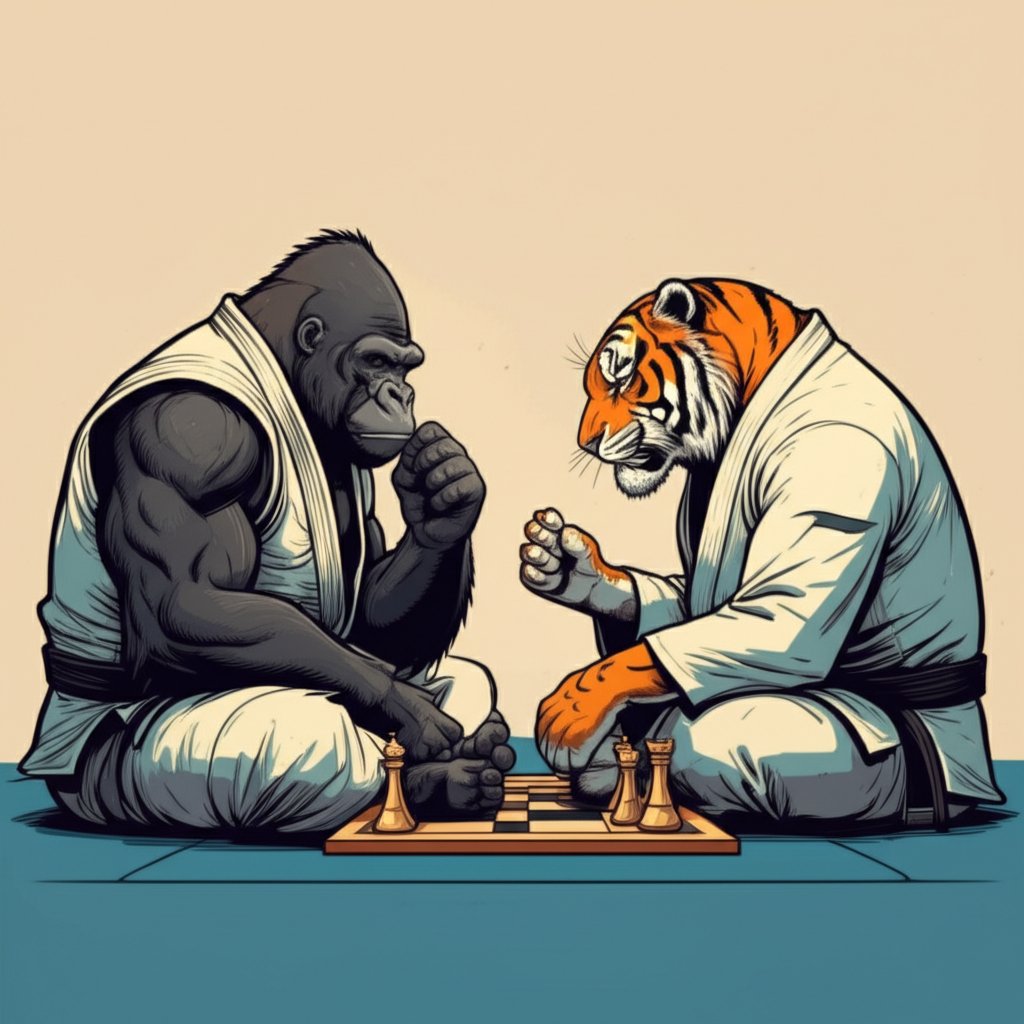
This is why practitioners of both disciplines often recognize each other. Chess players who discover BJJ feel an immediate kinship with the art. Grapplers who learn chess find the strategic thinking eerily familiar. Both are games of human chess—one played with pieces, the other with bodies.
Opening Theory: The First Contact
In chess, opening theory has been studied for centuries. The Sicilian Defense, the Queen's Gambit, the French Defense—grandmasters memorize hundreds of opening lines, understanding that the first several moves establish the strategic framework for everything that follows.
BJJ has its own opening theory. Standing, you might favor an underhook battle, collar-and-sleeve grip fighting, or immediate level changes. On the ground, guard players develop systematic entries while passers drill their favorite engagement sequences. Just as a chess player who opens 1.e4 plays a fundamentally different game than one who opens 1.d4, a guard player who starts in De La Riva creates different problems than one who pulls half guard.
The parallel deepens when you consider how openings set the tone. An aggressive chess opening puts your opponent on the defensive early. An aggressive BJJ opening—perhaps an immediate shot or forceful grip sequence—does the same. Conversely, solid, patient openings in both disciplines prioritize long-term positional advantage over quick attacks.
Controlling the Center: Territory and Space
Chess coaches hammer home one principle above all others: control the center. The four central squares (d4, d5, e4, e5) provide maximum mobility for pieces and restrict opponent options. A player who dominates the center often dominates the game.
BJJ has an analogous concept, though it manifests differently. Instead of board squares, you control space through grips, frames, and body positioning. A strong inside position in the clinch—like an underhook or body lock—functions like central control in chess. It limits your opponent's options while maximizing yours.
From guard, controlling distance and hip angle serves the same purpose. A well-established guard position, like a chess piece planted in the center, radiates influence across the entire "board" of possible exchanges. Poor positioning leaves you cramped and reactive, just like pieces stuck on the back rank with no room to maneuver.
Positional Advantage: The Slow Squeeze
Neither chess nor jiu-jitsu rewards recklessness. Yes, brilliant tactical shots exist in both—a queen sacrifice that leads to checkmate, a flying armbar from closed guard—but consistent success comes from accumulating small positional advantages.
In chess, this might mean slightly better piece placement, a superior pawn structure, or control of key files and diagonals. None of these advantages wins immediately. But they compound, slowly restricting your opponent until the winning combination appears.
BJJ's hierarchy of positions works identically. Moving from guard to half guard to side control to mount represents steady positional improvement. Each transition grants more control and more attacking options while limiting your opponent's escapes. You do not need to submit someone from every position. You need to improve position until the submission becomes inevitable.
This is why experienced grapplers often appear to win effortlessly. They have spent years learning to accumulate micro-advantages—a grip here, an angle there—until their opponents are positionally bankrupt.
Sacrifices: Giving to Get
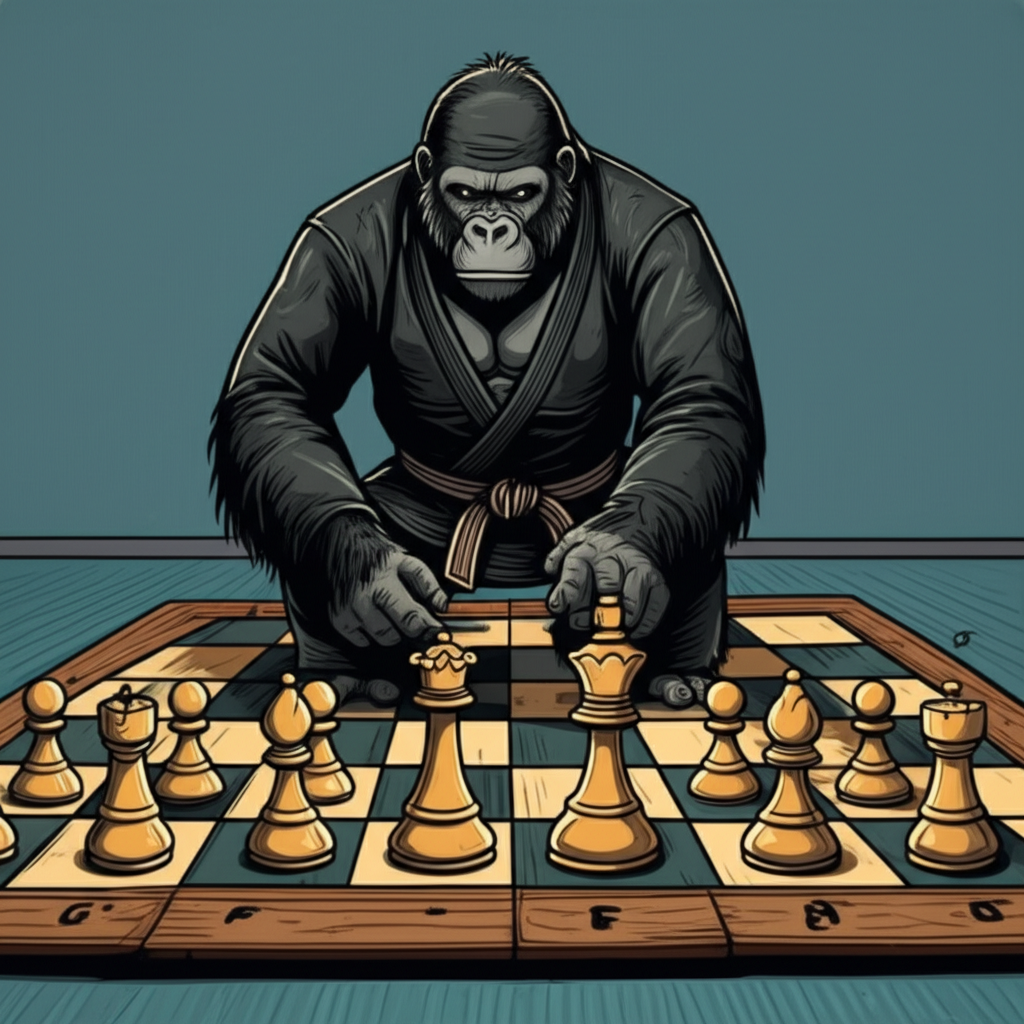
One of chess's most beautiful concepts is the sacrifice—deliberately giving up material (a piece worth points) to gain something intangible but more valuable (position, tempo, or initiative).
BJJ practitioners make sacrifices constantly. Giving up an underhook to set up a throw. Allowing guard to be passed to expose a back-take opportunity. Releasing a grip to attack a submission. The currency differs, but the concept is identical: temporary loss for long-term gain.
Great grapplers, like great chess players, understand when sacrifice is appropriate. They see three moves ahead and recognize that what looks like a mistake is actually the setup for something devastating.
Chains and Combinations: Linking Attacks
No competent chess player throws out single-move attacks hoping they work. They construct combinations—sequences of forcing moves that create inexorable pressure regardless of how the opponent responds.
BJJ's attack chains follow the same logic. A triangle attempt that fails naturally leads to an armbar. The armbar defense exposes the omoplata. Each technique flows into the next, and the defender must solve multiple problems simultaneously.
This is what separates blue belts from black belts more than any individual technique. Black belts chain positions and attacks so seamlessly that escaping one threat lands you directly in another. They are not reacting to what you do—they are controlling what you can do, herding you toward the outcome they have already visualized.
Pattern Recognition: The Master's Eye
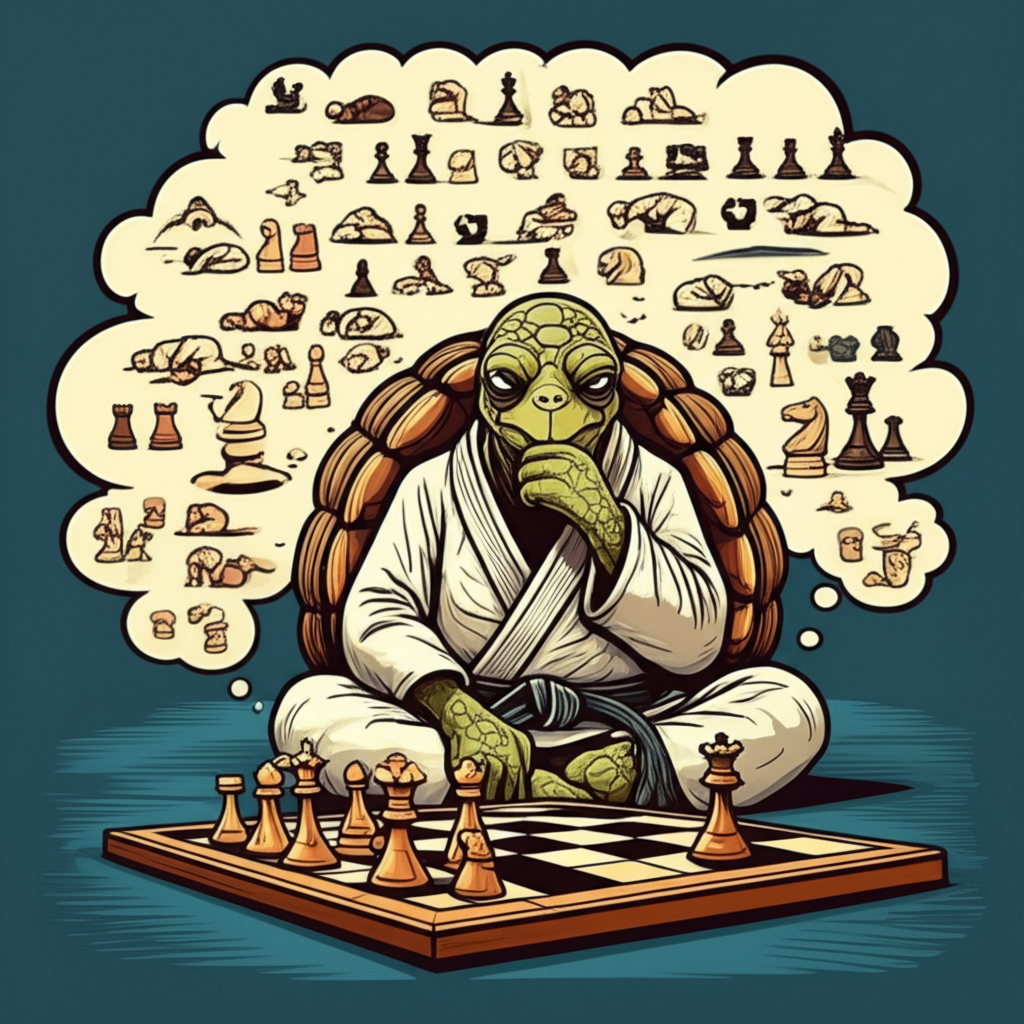
After thousands of games, chess masters develop almost supernatural pattern recognition. They glance at a position and instantly see tactical motifs—pins, forks, skewers, back-rank weaknesses—that beginners would miss entirely.
BJJ develops identical pattern recognition. Experienced grapplers see frames, angles, weight distribution, and grip combinations with the same instant clarity. Where a white belt sees chaos, a black belt sees a half-dozen attacks and the likely sequence of exchanges.
This pattern recognition cannot be taught directly. It emerges from thousands of repetitions, thousands of sparring rounds, thousands of positions experienced and studied. Both chess and BJJ reward obsessive practice because both disciplines are fundamentally about building a mental library of patterns.
The Mental Game: Reading Your Opponent
Finally, both chess and jiu-jitsu are psychological battles as much as technical ones. Reading your opponent—their tendencies, their emotional state, their likely responses—provides advantages that pure technique cannot.
Does your opponent panic when pressured? Apply relentless pressure. Do they become impatient in even positions? Play solidly and wait for their mistake. Are they overconfident after early success? Set traps that exploit their aggression.
Great competitors in both disciplines cultivate poker faces, disguise their intentions, and execute feints designed to provoke specific responses. The highest levels of chess and BJJ are mind games played through physical mediums.
The Gentle Art of Human Chess
Perhaps the comparison between chess and jiu-jitsu resonates because both disciplines offer something rare: infinite complexity within bounded systems. The rules are finite. The possibilities are not.
Both reward long-term study with compound returns. Both humble beginners while revealing ever-deeper layers to masters. Both attract a certain type of mind—analytical, competitive, endlessly curious about optimization and improvement.
If you practice jiu-jitsu and have never tried chess, consider it. The strategic thinking transfers directly. If you play chess and have never tried BJJ, find a gym. You will recognize the feeling immediately.
In the end, both arts teach the same lesson: victory goes not to the strongest or fastest, but to the one who thinks most clearly under pressure.
Ready to sharpen your strategic thinking? Explore BJJChat's AI Coaching article to get personalized guidance on developing your positional game, or track your progress through BJJ's "opening theory" with the Belt Curriculum Tracker.
About the Author

BJJChat Team
VariousEditorial Team
The BJJChat editorial team is a collective of Brazilian Jiu-Jitsu practitioners, coaches, and enthusiasts dedicated to sharing knowledge and helping the BJJ community grow. With combined experience spanning decades of training across multiple academies worldwide, our team produces content on platform updates, training tools, community features, and general BJJ tips. We are passionate about making quality BJJ education accessible to everyone, from white belts just starting their journey to experienced competitors looking to refine their game.
Ready to Track Your Progress?
Join practitioners who log their sessions and see real improvement over time.
Start Tracking