
Using Ecological BJJ: A Constraints-Led Approach to Training
Learn how ecological BJJ uses constraints-led training to transform skill development. Master task, environment, and individual constraints for faster learning.
Share this page
Ready to Track Your Progress?
Join practitioners who log their sessions and see real improvement.
If you have ever watched a child learn to walk, you know something interesting: nobody teaches them step-by-step instructions. They fall, adjust, try again, and eventually figure it out through exploration. This natural learning process is exactly what ecological BJJ aims to harness for jiu-jitsu development.
For decades, the traditional BJJ teaching model followed a predictable pattern: instructor demonstrates technique, students drill in pairs, everyone lines up for positional sparring. While this approach produces competent grapplers, a growing number of coaches are discovering that a constraints-led approach produces practitioners who can truly problem-solve under pressure.
Welcome to ecological BJJ, a training methodology that is quietly revolutionizing how we learn the gentle art.
What Is Ecological BJJ?
Ecological dynamics is a framework borrowed from motor learning science that views skill acquisition as an ongoing interaction between the individual, the task, and the environment. Rather than treating techniques as isolated movements to be memorized and replicated, ecological BJJ sees them as solutions that emerge when the right conditions are present.
The core concept is perception-action coupling: the idea that what we perceive and how we move are inseparable. A traditional approach might teach the scissor sweep as a series of steps. An ecological approach creates situations where the scissor sweep naturally emerges as the best available solution.
This does not mean abandoning technique instruction entirely. It means recognizing that showing someone a technique is only the beginning. True skill development happens when practitioners discover how and when to apply techniques through guided exploration.
The Three Types of Constraints
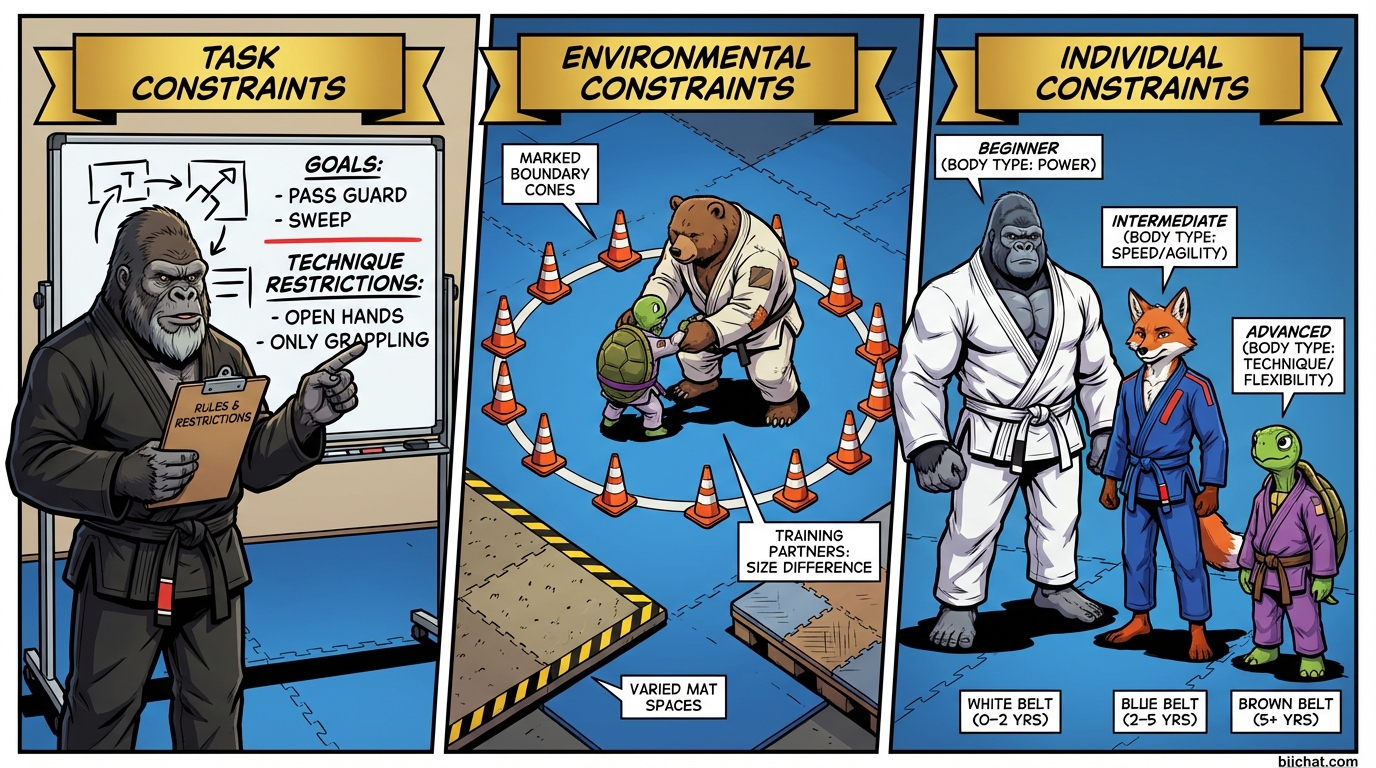
The constraints-led approach identifies three categories of constraints that coaches can manipulate to guide learning:
Task Constraints
Task constraints are the rules, goals, and equipment that define what practitioners are trying to accomplish. In BJJ training, these include:
- Scoring rules: Pass guard versus sweep to win
- Time limits: Finish in 60 seconds or lose
- Technique restrictions: Submissions only, no grips on pants, guard player cannot use hands
- Objectives: Get to mount without using your hands, maintain back control for 30 seconds
By adjusting task constraints, coaches create scenarios where specific solutions become advantageous. Want your students to develop better underhook retention? Create a game where the underhook is the only way to score.
Environmental Constraints
Environmental constraints involve the physical space, training partners, and external conditions:
- Mat space: Smaller areas force urgency and commitment
- Partner size: Training with larger or smaller partners changes available options
- Number of opponents: Shark tank formats develop survival instincts
- Equipment: Using crash pads, walls, or restricted spaces
A common environmental manipulation is limiting mat space. When practitioners cannot back away endlessly, they must engage. This simple change produces more realistic training that transfers better to competition.
Individual Constraints
Individual constraints are the physical and psychological characteristics each practitioner brings:
- Body type: Limb length, flexibility, strength ratios
- Experience level: What techniques are already in the toolbox
- Injury status: What movements are currently available
- Mental state: Confidence, focus, fatigue
Effective coaches recognize that the same game works differently for different body types. A long-legged practitioner will naturally gravitate toward different solutions than a compact wrestler-type. Ecological BJJ embraces this diversity rather than forcing everyone into identical technique execution.
Practical Applications for Your Academy
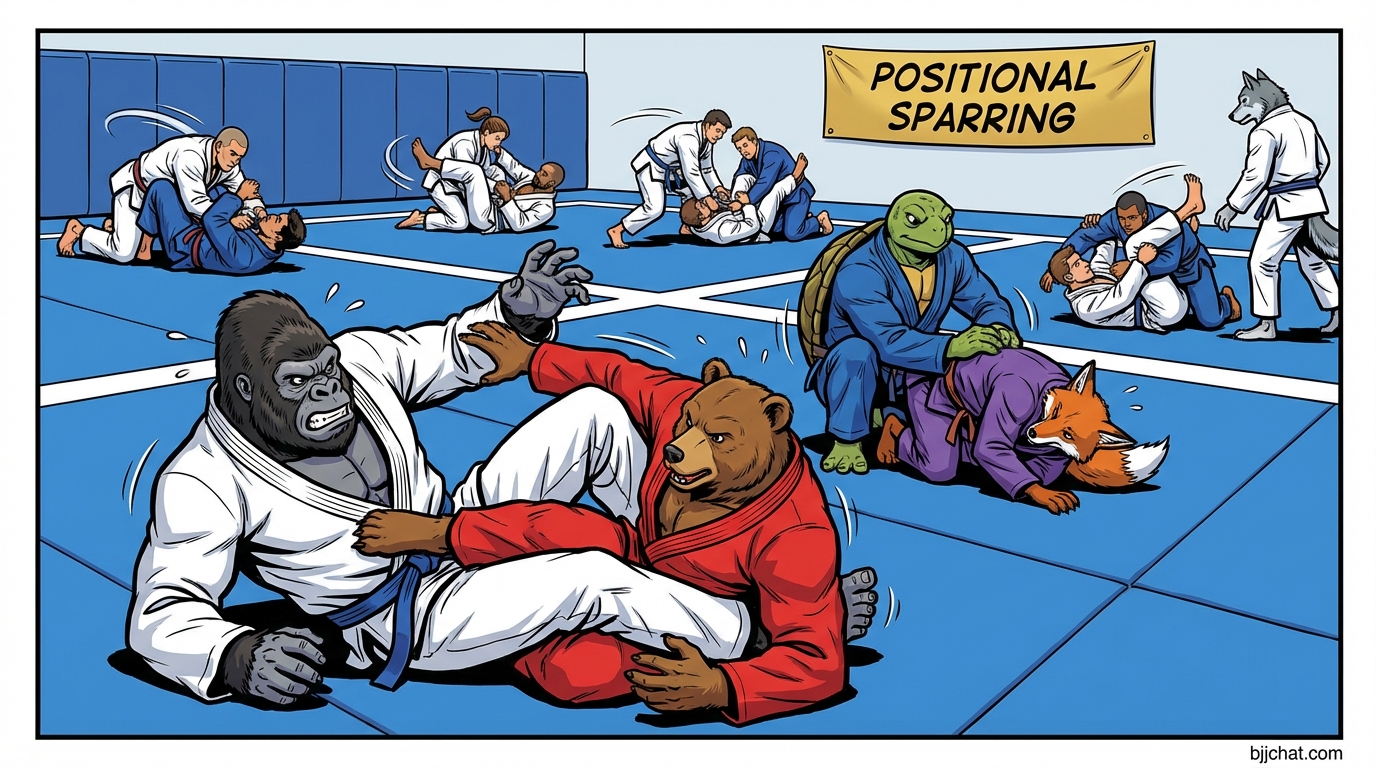
Understanding the theory is one thing. Implementing it transforms your training. Here are concrete ways to apply ecological principles:
Small-Sided Games
Instead of drilling techniques in isolation, create games with clear objectives:
Guard Retention Game: Guard player starts with closed guard. Passer wins by clearing both legs. Guard player wins by sweeping or submitting. Reset after each win. Play 3-minute rounds.
Back Attack Battle: One player starts with back control (hooks in, seatbelt grip). Defender wins by escaping to guard or clearing the hooks. Attacker wins by submission. Adjust starting position based on skill level.
Underhook Wars: Both players start in standing clinch. First to secure double underhooks wins the point. Reset and repeat. Players naturally develop underhook offense and defense through competition.
These games are more engaging than traditional drilling, provide immediate feedback, and develop skills that transfer directly to live sparring.
Constraint Manipulation Examples
Problem: Students are too passive when passing guard.
Solution: Reduce mat space by 50%. Add a time limit. Award points only for passes, not sweeps. The environmental pressure forces commitment.
Problem: Students always rely on the same two submissions.
Solution: Ban their favorite submissions for a week. Create a game where points are awarded for different submission attempts. The task constraint forces exploration of their B-game.
Problem: New students struggle with the chaos of live sparring.
Solution: Start with narrowly defined games (guard retention only, no submissions). Gradually add complexity as competence develops. The progressive constraint removal builds confidence.
The Coach's Role in Ecological Training
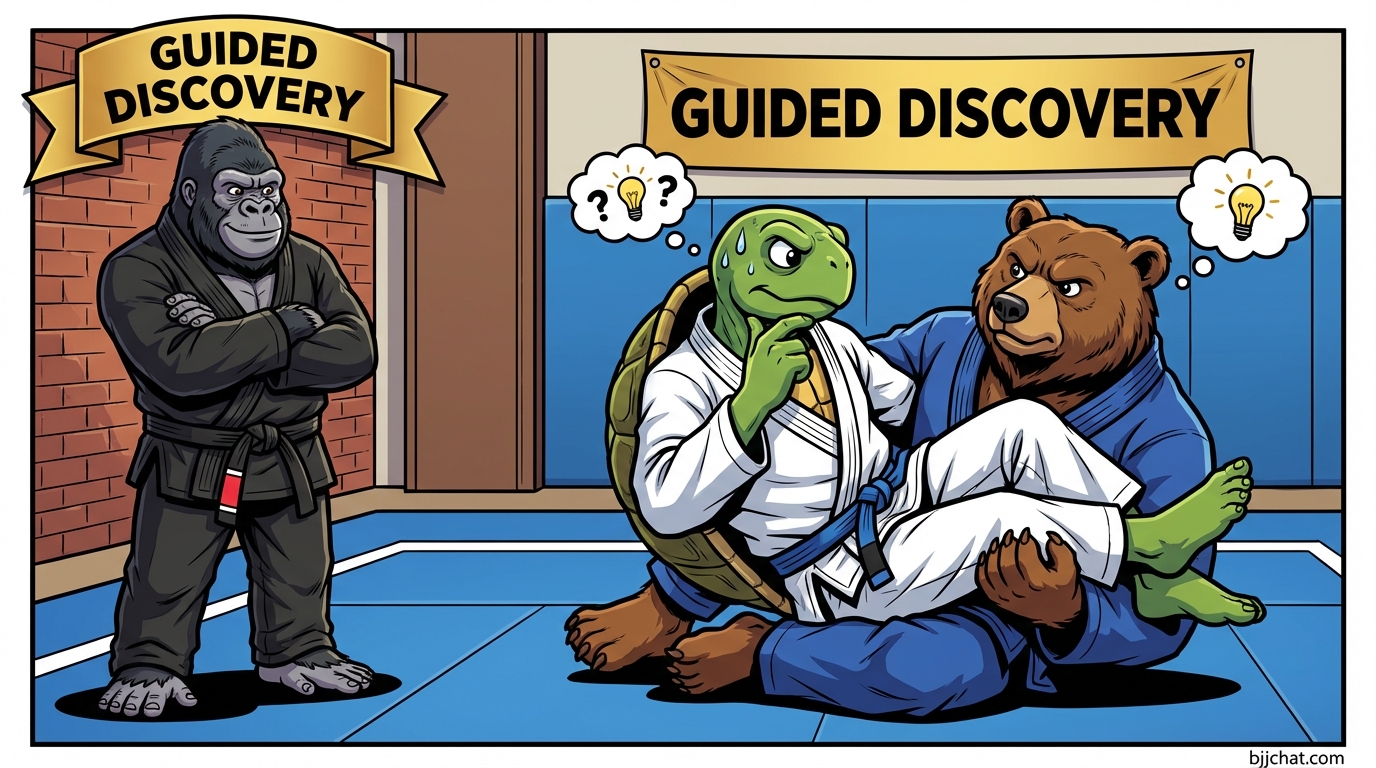
In constraints-led coaching, the instructor's role shifts from demonstrator to architect. Rather than showing and correcting technique details, you design training environments and observe what solutions emerge.
This does not mean becoming passive. Effective ecological coaches:
- Set clear objectives before each training game
- Observe patterns across multiple repetitions
- Ask guiding questions rather than giving answers ("What happened when you tried to pass on that side?")
- Adjust constraints based on what they see
- Provide minimal cueing when practitioners are stuck
The goal is creating skilled problem-solvers, not technique replicators. When your students face unfamiliar situations in competition, you want them asking "What options do I have?" not "What did my coach tell me to do?"
Benefits of Ecological BJJ Training
Coaches who adopt constraints-led methods consistently report several advantages:
Better Retention: Skills developed through exploration stick better than those acquired through repetition alone. When students discover solutions themselves, they understand the why behind the technique.
More Engaged Students: Games are inherently more fun than drilling. Students stay focused longer, train with more intensity, and look forward to class.
Improved Decision-Making: Because ecological training emphasizes perception and choice, practitioners become better at reading situations and selecting appropriate responses.
Competition Transfer: Training environments that resemble competition—with pressure, consequences, and resistance—produce skills that work when it matters.
Individual Adaptation: Rather than forcing everyone into identical technique execution, ecological training allows body types and preferences to shape each student's game naturally.
Getting Started with Constraints-Led Training
Ready to bring ecological principles into your training? Start small:
-
Choose one training game and use it to replace 10 minutes of drilling each class. Observe what happens.
-
Identify a common problem your students face. Design a game where solving that problem leads to winning.
-
Experiment with space constraints. Try limiting mat space by 25-50% during positional sparring and notice the difference in engagement.
-
Ask more questions. Instead of correcting immediately, ask students what they noticed, what worked, and what they might try differently.
-
Use BJJChat's training games library to find proven games organized by skill level, position focus, and training objective. Each game includes built-in constraint variations you can apply.
The shift to ecological training does not happen overnight. Start with small experiments, observe the results, and gradually expand what works.
Conclusion
Ecological BJJ is not about abandoning technique instruction or letting chaos reign. It is about recognizing that true skill develops through guided exploration, not passive memorization.
By understanding and manipulating task, environmental, and individual constraints, coaches create training environments where effective techniques naturally emerge. Students become problem-solvers who can adapt to whatever situations they encounter on the mats.
The gentle art has always been about efficiency—using leverage and timing rather than strength alone. Ecological training applies that same principle to learning: working with natural skill acquisition processes rather than against them.
Ready to explore ecological training for your academy? Browse the BJJ Training Games library for constraint-based drills you can use today, or try the AI Drill Plan Generator to create custom training sessions based on your students' development needs.
Interested in more coaching methodology? Check out our resources on training analytics to track student progress, or explore how AI coaching can supplement your instruction with personalized feedback.
About the Author

BJJChat Team
VariousEditorial Team
The BJJChat editorial team is a collective of Brazilian Jiu-Jitsu practitioners, coaches, and enthusiasts dedicated to sharing knowledge and helping the BJJ community grow. With combined experience spanning decades of training across multiple academies worldwide, our team produces content on platform updates, training tools, community features, and general BJJ tips. We are passionate about making quality BJJ education accessible to everyone, from white belts just starting their journey to experienced competitors looking to refine their game.
Ready to Track Your Progress?
Join practitioners who log their sessions and see real improvement over time.
Start Tracking

